01 · Overview
Overview
This is an end-to-end machine learning project that predicts whether a telecom customer will churn or stay. It works with the Telco Customer Churn dataset (7,043 rows, 20 features). The whole flow — cleaning data, training models, tuning hyperparameters, and saving the final model — is wrapped into one reusable pipeline.
02 · How I built this project
How I built this project
- Loaded and inspected the dataset with Pandas.
- Split the data into 80% train and 20% test, keeping the churn ratio the same in both.
- Built a preprocessing pipeline:
- Numeric columns: median imputation + StandardScaler
- Categorical columns: mode imputation + OneHotEncoder
- Binary columns: passed through as-is
- Combined preprocessing with two models: Logistic Regression and Random Forest.
- Tuned both models with GridSearchCV (5-fold cross-validation).
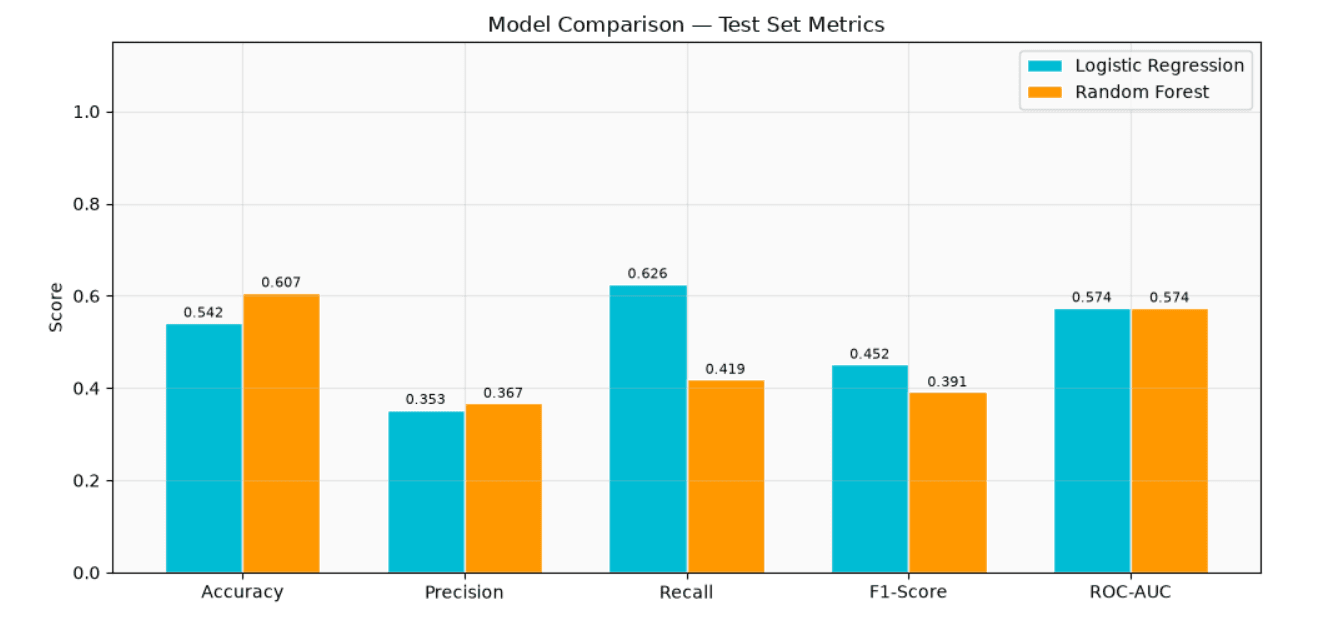
- Compared the models on accuracy, precision, recall, F1, and ROC-AUC.
- Saved the best pipeline with Joblib so it can be reused with one line of code.
03 · Tech stack
Tech stack
- Language: Python 3.11
- Data handling: Pandas, NumPy
- Machine learning: Scikit-learn (Pipeline, ColumnTransformer, GridSearchCV)
- Models: Logistic Regression, Random Forest
- Plots: Matplotlib, Seaborn
- Model saving: Joblib
04 · Results
Results
| Model | Best CV AUC | Test Accuracy | Test ROC-AUC |
|---|---|---|---|
| Logistic Regression | 0.5577 | 0.6984 | 0.5737 |
| Random Forest | 0.5511 | 0.6991 | 0.5642 |
- Logistic Regression won and was saved as the final model.
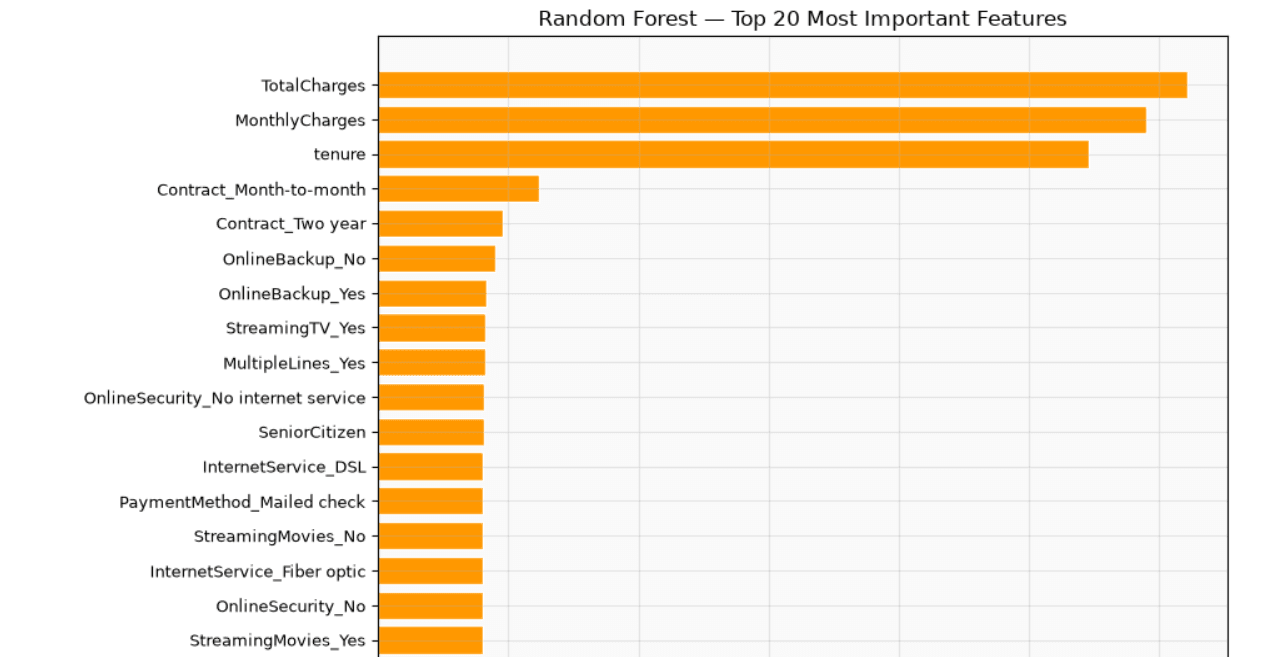
- Top churn signals: tenure, MonthlyCharges, and Contract type.
- Month-to-month customers churn the most.
- The saved pipeline handles missing values on its own, so it works on raw data with no extra steps.
Code and more on GitHub
Repositories, experiments and smaller builds.
3 projects · 4 sectionsOverview